


Losing a tooth, or several teeth, is more common than many people realise, and the good news is that there are excellent ways to replace them. Two of the most popular options in the UK are dentures and dental bridges, with dental implants offering a third route.
Each works in a different way, and each suits different situations, so the best choice really comes down to your mouth, your priorities and your budget.
This guide compares dentures and bridges in plain terms. We explain how each one works, the key differences between a partial denture and a fixed bridge, how they compare on cost, maintenance, longevity and the effect on your other teeth, and where implant-supported options fit in.
What are dentures?
Dentures are removable replacements for missing teeth. A full denture replaces a complete arch of teeth, while a partial denture replaces one or more missing teeth and fits neatly around the natural teeth you still have. Partial dentures usually use small clasps or a slim framework to stay securely in place while you eat and talk.
One of the biggest advantages of dentures is their versatility. They can be made to replace any number of teeth, from a single gap to a full arch, and they generally do not require any alteration to your healthy natural teeth. They are also the most affordable way to replace missing teeth, and they can be adjusted or added to over time. You take them out for cleaning and, ideally, overnight, which gives your gums a chance to rest.
What are dental bridges?
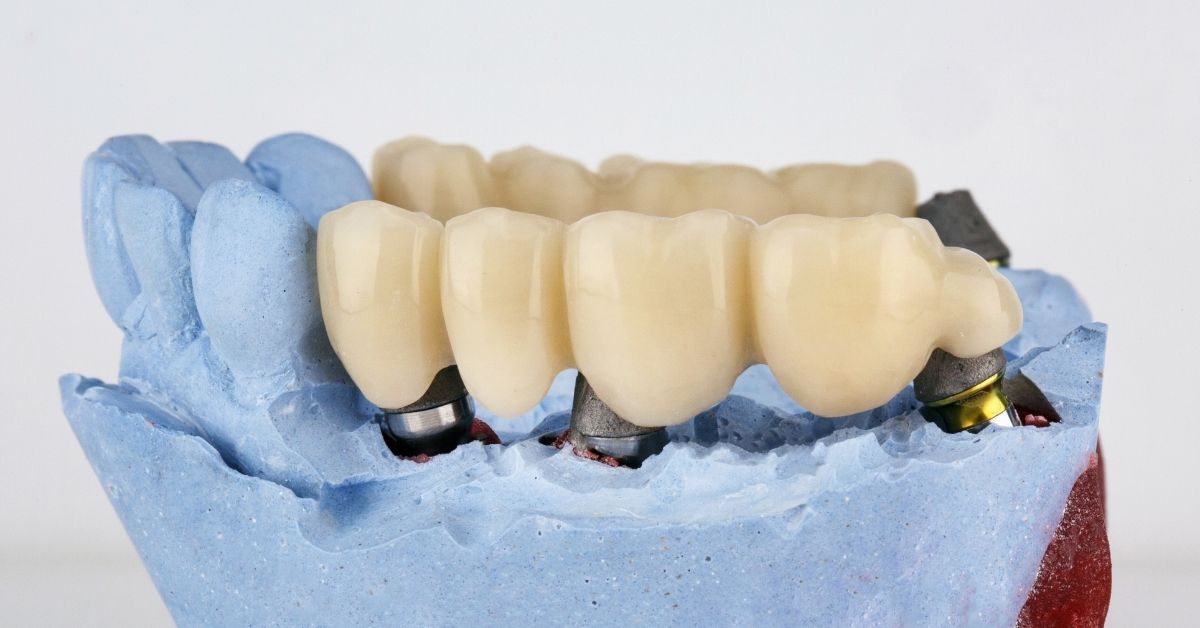
A dental bridge is a fixed replacement for a missing tooth or teeth. Rather than being removable, it is cemented in place, so it stays put and feels much like a natural tooth. A bridge is made up of one or more false teeth, known as pontics, which are held in position by the teeth or implants on either side of the gap.
There are a few different types of bridge:
- A traditional bridge: it uses crowns on the healthy teeth on both sides of the gap to support the false tooth in the middle
- A cantilever bridge: this is anchored on one side only, and a Maryland bridge, also called a resin-bonded bridge, uses thin wings bonded to the backs of the neighbouring teeth, which involves far less preparation
- An implant-supported bridge: this type is anchored to dental implants rather than natural teeth, which is often the choice when several teeth are missing or the neighbouring teeth are not strong enough to act as supports
What is the difference between dentures and bridges?
The most fundamental difference is that a denture is removable and a bridge is fixed in place. When people weigh up dentures and bridges, the fairest comparison is usually between a partial denture and a traditional bridge, as these are the options most people are choosing between. The table below sets out how they compare.
| Feature | Partial Denture | Fixed Bridge |
| Fixed or removable | Removable | Fixed in place |
| Teeth it replaces | One tooth up to a full arch | Usually one to three in a row |
| Effect on other teeth | Usually no alteration needed | Neighbouring teeth often reshaped |
| Stability | Very good, though it can move slightly | Feels like a natural tooth |
| Cleaning | Removed for cleaning | Cleaned in place, including under the pontic |
| Typical lifespan | Around 5 to 8 years for acrylic | Around 10 to 15 years |
| Cost | The more affordable option | A higher investment |
Partial dentures vs bridges: a closer look
The table gives you the headlines, but a few points are worth exploring in more detail so you can see how the two options really differ day to day.
Permanence and feel. A bridge is fixed, so you never take it out, and many people love the security of a replacement that behaves just like a natural tooth. A partial denture is removable, which some people prefer for cleaning, though it can feel slightly less stable than a fixed option, particularly at first.
Impact on surrounding teeth. This is one of the most important differences. A traditional bridge relies on filing down the healthy teeth either side of the gap so they can be crowned, which permanently changes those teeth. A partial denture generally leaves your natural teeth untouched, which is a real advantage if the neighbouring teeth are healthy and you would rather not alter them.
Maintenance. A denture is taken out for cleaning, which makes it easy to keep every surface spotless, and our guide to cleaning your dentures explains the routine. A bridge is cleaned in place, and you need to clean carefully underneath the false tooth using special floss or an interdental brush, as this area can trap plaque.
Longevity. A well-made bridge often lasts somewhere around ten to fifteen years, though this varies from person to person and depends on the type of bridge and how well it is cared for. Dentures also last well and can be relined or adjusted as your mouth changes, and you can read more about how long dentures last and when to replace them. It is also worth knowing that a bridge replaces only the crown of the tooth and not the root, so the bone beneath the gap can gradually shrink over time.
Dentures vs bridge cost
Cost is understandably a big factor, and in general a partial denture is the more affordable choice, especially when you need to replace several teeth. A bridge is usually a higher investment because of the crowns, materials and laboratory work involved, and an implant-supported bridge sits higher still.
On the NHS in England, both dentures and bridges that are clinically necessary fall under the same Band 3 charge, currently £332.10. Privately, prices vary depending on the design, the materials and your individual needs. You can see our own denture pricing for a clear guide, with dentures starting from £595, and we will always talk you through the costs openly before you commit to anything.
Where do implants fit in?
Dental implants are a third option, and they can work alongside both bridges and dentures. An implant is a small titanium post placed into the jawbone, where it acts as an artificial tooth root. Because it replaces the root as well as the crown, an implant helps to preserve the bone and provides a very stable foundation.
When people compare a denture or bridge with implants, there are really a few routes to consider. A single implant can support one crown, an implant-supported bridge can replace several teeth without relying on the natural teeth either side, and implant-retained dentures clip onto implants for extra security while still being removable. Implants tend to last the longest and feel the most natural, but they are the biggest investment, they involve minor surgery, and they need enough healthy bone to support them. Our article comparing dental implants and dentures goes into more detail, and you can also read about our dental implant options.
When is a bridge the better choice?
A bridge can be an excellent option in the right circumstances. It often makes sense when:
- you are missing one tooth or a small number of teeth in a row
- the teeth on either side of the gap are healthy and strong enough to provide support
- you would prefer a fixed replacement that you never have to take out
- you want something that feels and functions much like a natural tooth
When is a denture the better choice?
A denture is frequently the better route when:
- you are replacing several teeth, or teeth in different parts of the mouth
- you would rather not have your healthy neighbouring teeth reshaped
- the teeth around the gap are not strong enough to support a bridge
- you are looking for a more affordable solution
- you may need to add further teeth to the appliance in future
Dentures are also wonderfully versatile, and modern options such as suction dentures can offer an impressively secure, comfortable fit. You can explore the full range of denture options to see what might suit you.
So, which is better, a bridge or a denture?
There is no single answer that is right for everyone, because the best option genuinely depends on your circumstances. The number and position of your missing teeth, the health of your remaining teeth and gums, the condition of the bone, your budget and your personal preferences all play a part. For one person a fixed bridge will be ideal, while for another a comfortable, well-designed partial denture will be the better fit, and for a third an implant-based solution will suit best.
The most reliable way to decide is to have a proper assessment with an experienced professional who can look at your mouth and talk you through the options honestly. That way you can make a confident, well-informed choice rather than guessing.
Get expert advice at Kevin Manners Denture Clinics
At Kevin Manners Denture Clinics, we specialise in high-quality, natural-looking dentures, and we also work closely with trusted implant dentists, so we can help you understand which tooth replacement option is genuinely right for you. With clinics in Nottingham, Mansfield and Newark, and more than 30 years of experience, our team takes the time to explain your choices clearly and without any pressure.
Every denture is designed and handcrafted by our Clinical Dental Technician for a comfortable fit and a natural finish. You can browse our before and after gallery and read genuine patient reviews to see the difference for yourself. Trusted, independent advice on caring for your teeth and dentures is also available from the Oral Health Foundation.
If you are weighing up dentures, a bridge or implants and would like some friendly guidance, book your free consultation or get in touch with our team today. We will help you find the right way forward for a healthy, confident smile.